
Oishi narrating (tail wagging)
“Ang kampana’y tuluyang nanggigising
Upang tayong lahat ay manalangin…”
The melody floats through the street like warm pandesal. I’m pretty sure the song says something about hope, but I’m a dog, not a theologian. I just know I like the sound.
I’m standing on the windowsill, watching a small group of carolers outside our gate—with tambourines, guitars, and that one tito who sings slightly off-key but with full conviction. I bark at them, but it’s a good bark. The “please continue, I am being serenaded” bark.
I’m happily vibing when suddenly—click.
All the lights in the house go off.
I glance back and see Sus at the switch, wallet in hand, staring at it like it just gave her bad news. Salary is still a few days away, and she has already spent her money on Christmas décor, premium peanuts, a squeaky toy for me, and of course… siopao.
“Badoodle, don’t go near the window, let’s hide,” she whispers, as if we’re fugitives. She peeks through the curtain, then pulls me away.

“I don’t have spare change,” she mutters. “Can you tell them patawad?”
As if I can talk. I mean, I could if I wanted… but I’m choosing peace.
She scoops me up, closes the curtains, and promises, “I’ll give on the 24th, okay?”
Welcome to Christmas budgeting with Susan V.
The Tradition Behind Our Sleep Deprivation
Misa de Gallo—Simbang Gabi—is a Filipino tradition: nine dawn Masses from December 16 to 24. In theory it is a peaceful, holy preparation for Christmas. In practice, your local philosufurr is half-asleep, smelling like someone who bathed in kerosene fumes.
But I’m still excited, because after Mass, Sus and I always buy putobumbong and bibingka. That’s also tradition. The choir, the cool dawn air, the soft murmur of people praying—it’s actually very calming.
I’m watching the choir, tail gently wagging, when I turn to Sus to say with my eyes, “This is nice, isn’t it?”
She’s half-asleep.
Of course. Classic Sus.
Susan narrating (sleepy)
I have been yawning non-stop since December 16.
Oishi and I have been attending Simbang Gabi. Nine dawn Masses to prepare for the birth of Jesus and to honor Mama Mary. People say if you complete all nine, God will grant your prayer. Theologically, I know God isn’t a vending machine—but still, my heart said, Maybe this year, Lord?
So I told myself, I can do this! I’ve completed it before, I can do it again.
First two days, I was so determined. I set my alarm for 3:00 a.m., dragged myself to the shower, jumped around like a frog because the water was freezing, got dressed, and headed out.

December air hits differently. Cool, quiet, a little magical. You hear distant chitchat, slippers on pavement, scooters passing by. Teenagers stand outside the church “attending Mass” but mostly vibing with friends. (No judgment, I was that teen.) There are families, couples, lola with her apo, peers—everyone half-asleep but present.
The choir started singing.
I… knocked out.
I tried biting my tongue to stay awake. Didn’t work. I woke up because Oishi was gently biting my arm like, “Ma’am, respectfully, wake up, the Lord is speaking.”
“Okay, okay, I’m awake,” I whispered, scooping him up and hugging him like a stress ball.

Quietly, I told God, How long do I have to wait, Lord? You’ve given me everything I need—but why not what I want? It’s not like I’m asking to be a drug lord or criminal mastermind.
The first reading ended. Then came the line that grabbed me:
“But when all goes well with you, remember me and show me kindness;
mention me to Pharaoh and get me out of this prison.”
— Genesis 40:14
The priest began talking about Joseph—not Joseph, the husband of Mary, but Joseph the dreamer.
From beside me Oishi muttered in my brain, “They know, Sus. Paw to forehead.”
Joseph’s Story (as told by the priest, and slightly by me)
Joseph was Jacob’s favorite son, the one with the colorful robe and the dreams. In his dreams, their bundles of grain bowed to his, and even the sun, moon, and stars bowed to him. Naturally, his brothers did the mature thing: they hated his guts.
They threw him into a pit, sold him to traders, and told their father a wild animal had killed him. Joseph ended up in Egypt, working for Potiphar, an official of Pharaoh.
He was faithful there, but then Potiphar’s wife falsely accused him, and he landed in prison.
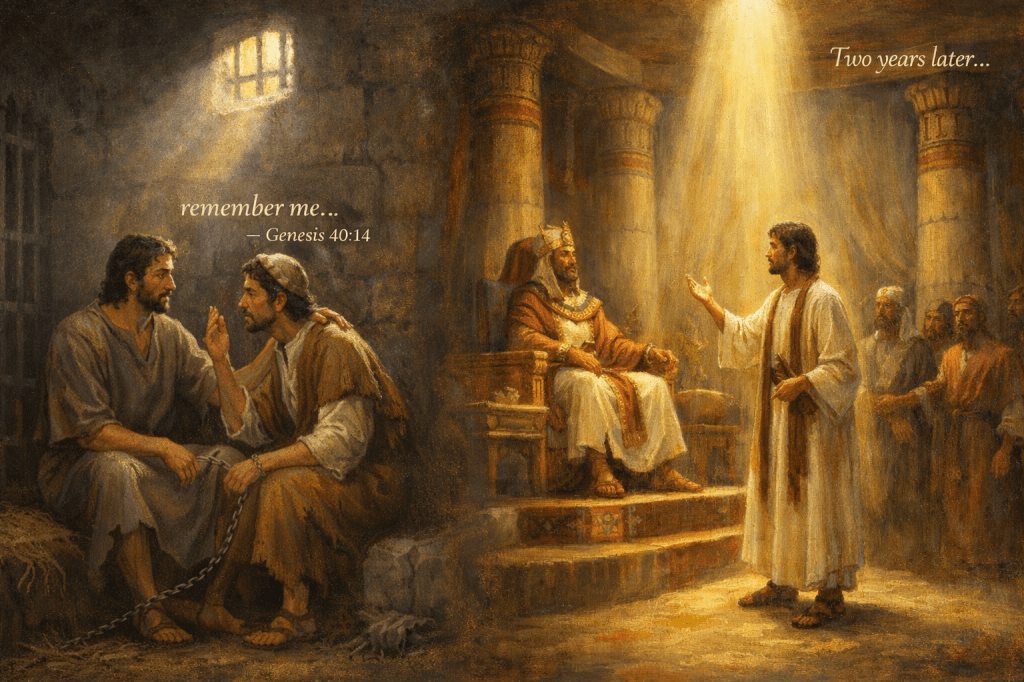
In prison, Joseph interpreted dreams for two of Pharaoh’s officials: the cupbearer and the baker. One would live, one would die. Joseph interpreted correctly, and before the cupbearer left he said, “When it goes well with you, remember me… mention me to Pharaoh.”
The cupbearer… forgot.
Two. Whole. Years.
Then Pharaoh had disturbing dreams about fat cows and skinny cows, full heads of grain and thin ones. No one could interpret them—until the cupbearer finally remembered: “Uhm, Your Majesty… about that Hebrew guy in prison…”
Joseph was brought before Pharaoh, interpreted the dream by God’s wisdom, explained that there would be seven years of plenty then seven years of severe famine, and suggested a plan to store grain. Pharaoh was so impressed he made Joseph second-in-command over all Egypt.
Because of that position, Joseph later saved his own family during the famine—yes, even the brothers who betrayed him. What they meant for evil, God bent toward good.
The priest said something like:
“If the cupbearer had remembered Joseph immediately,
maybe he would’ve left prison earlier—
but he would’ve walked out as an ordinary freed prisoner.
By God’s timing, he walked out as the man who would interpret Pharaoh’s dream
and be placed over Egypt.”
Not because Joseph was perfect, but because God’s plans and timing were bigger than anyone could see from inside that prison cell.
He reminded us that sometimes we’re like Joseph in the waiting phase. We pray and plead, but God doesn’t move the way we expect. Yet God has already said in Isaiah 55:8–9 that His thoughts and ways are higher than ours.
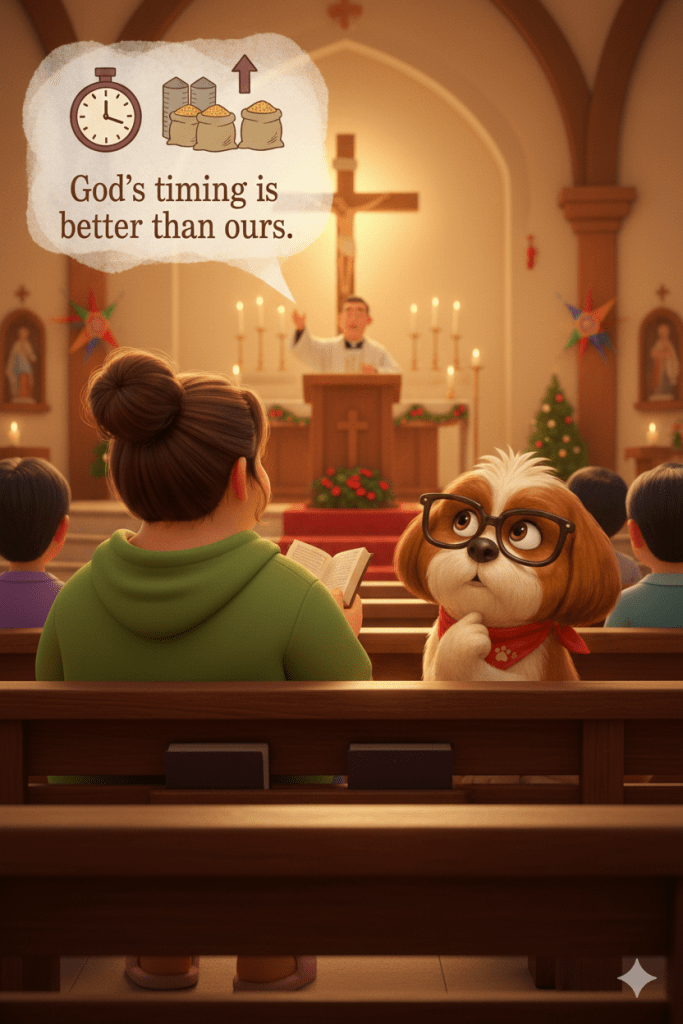
Waiting isn’t lying on the couch until heaven delivers a Shopee parcel. We pray, discern, ask the Holy Spirit for patience—and we still move. We work, study, knock on doors, apply, try again. God gave us brains, hands, and feet for a reason. We don’t wait passively; we wait with faith and intention, trusting that when He says “not yet” or “no,” it’s not cruelty—it’s wisdom.
Back to Susan in the pew
At some point in that homily, I realised I was fully awake.
I hugged Oishi (please don’t ask how I managed to smuggle him inside the church) and felt something in my chest loosen. I thought about all the times I made panicky decisions because I was scared God was taking too long. Times I rushed, grabbed Plan B, or settled for “at least may something,” and then ended up crashing hard.
I’m not saying I’ll stop bombarding heaven with prayers—I’m still Susan; I still talk a lot. But now, when I hear “God’s timing is perfect” and “His ways are higher than ours,” it doesn’t feel like a cliché thrown at me to shut me up.
It feels like Joseph in that cell. Seen. Remembered. Not forgotten—just not yet.
Since then, I’ve been trying (keyword: trying) to wait with a little more patience and a little more faith. To believe that His “no” and “wait” are not punishment, but protection.
After Mass, Badoodle and I rushed to buy bibingka and putobumbong. We went home, made coffee, and sat in the backyard. The sky was soft pink, the air cool. Roosters were crowing, a taho vendor passed by, tricycles started their morning routes. Nothing special—and yet everything alive.
I looked at the sunrise and prayed,
“God, You know how long I’ve been waiting.
Give me patience to trust You.
Thank You for the blessings You’ve already given—
and for the prayers You haven’t answered yet,
because one day I’ll see why You didn’t answer them my way.”

We sipped our coffee in silence.
Beside me, Oishi was busy quietly demolishing last night’s leftover chicken.
Simple morning. Still in the middle of the story.
And somehow… that was enough.
The end.
Still Rising. Still Barking. 🐾
Scripture references:
Joseph’s story – Genesis 37–50
God’s higher ways – Isaiah 55:8–9
 Ember - Fire and Soul
Leave a comment